GPSChianti
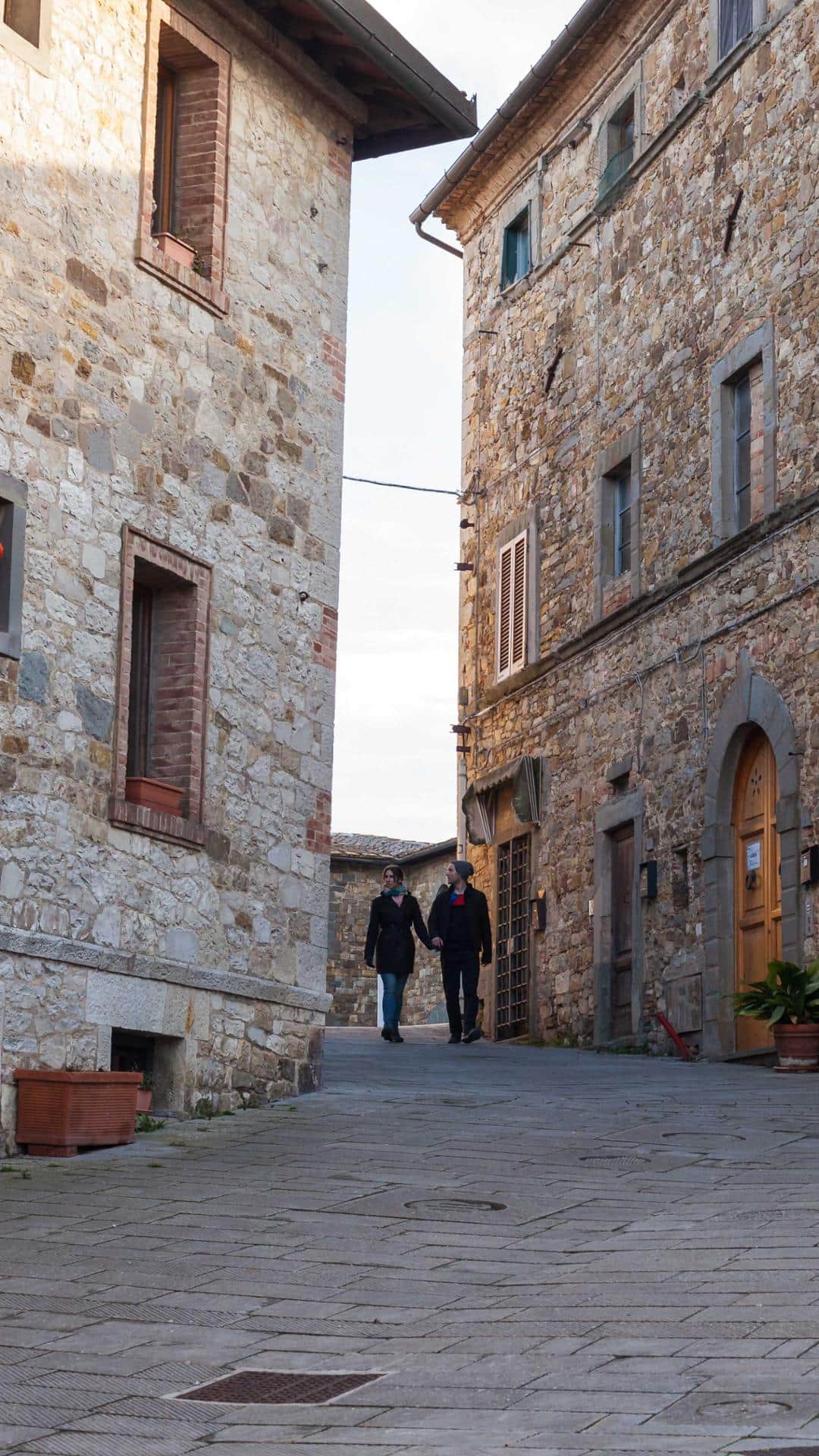
Castellina in Chianti has a characteristic medieval atmosphere. The main fortification is the Rocca with its imposing 14th century tower, forming part of the walls built by the Florentines, walls that encircled the whole town, interrupted only by the two gates one oriented towards Siena, the another towards Florence. It offers a spectacular view of the city and the surrounding countryside, this route has undergone changes over time, but has kept unchanged the charm resulting from the genius of Filippo Brunelleschi .
the Tunnel
Under the ancient walls runs an impressive underground tunnel, now known as the Via delle Volte , which houses shops, artisan shops and restaurants; the tunnel goes around the city, enclosing the historic center from underneath, the perfect place to look for some refreshment during the summer heat.
Archeology plays a key role
In this landscape there are two important archaeological sites: the Necropolis of Poggino and the Tumulus of Montecalvario . The latter site dates back to the sixth century BC. open to the public and dating back to the 6th century BC; it is characterized by 4 burning chambers facing north, south, east and west, each of which consists of a main (burning) room with side cells. The tomb was discovered in the 16th century, but as it was not excavated and protected adequately, in the early 1900s it was looted and robbed of many of its valuable artifacts. The most interesting find is, perhaps, that of the remains of the Etruscan "cart", reconstructed and exhibited at the Museum of Castellina.
Historical notes
Castellina in Chianti played a primary role due to its key position of connection between the southern Etruscan cities and the North. In 1200 it passed into the sphere of influence of Florence, after having been a fief of the Lords of Trebbio, of which it was a military garrison, above all due to its geographical proximity to Siena, the historical enemy of Florence. In this period it is the capital of the Lega del Chianti , including the territories of Gaiole in Chianti and Radda in Chianti, whose emblem is a black rooster, the same reproduced in the coat of arms of the Municipality of Castellina. In 1500 it definitively became part of the Grand Duchy of Tuscany, losing its strategic-military character and transforming itself into an agricultural center: its hills are covered with farms and cottages. In 1944 , during World War II, Castellina suffered the retreat of German troops, who placed a border line, destroying the ancient Florentine gate and the church of San Salvatore. The centuries-old military strategic role of Castellina is represented by the fifteenth-century Rocca Comunale which houses an Antiquarium with Etruscan finds, in whose courtyard the well can be admired.

Information

Nearby

No related places available